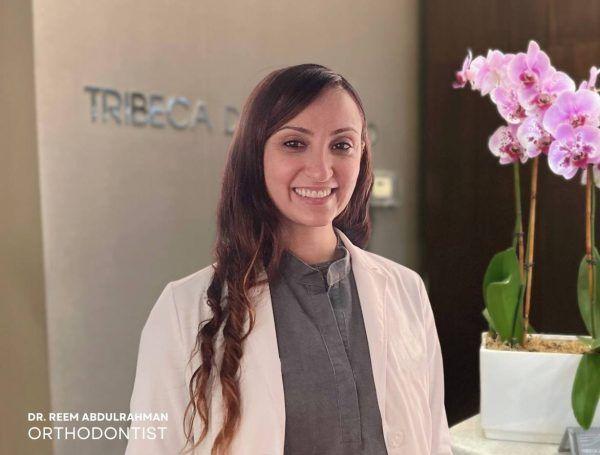
Dr. Reem Abdulrahman is a dedicated, full-time orthodontist (board-certified orthodontist). She completed her undergraduate and dental education at Temple University, earning her Doctorate of Dental Medicine in 2012. After graduation, Dr. Reem advanced her training at the Albert Einstein Medical Center's General Dental Practice Residency.
By the end of her first year, she was selected to remain for an additional year as chief resident, further refining her general dentistry skills.
Upon completing her two-year General Dental Practice Residency, she transitioned to private practice, working as a general dentist from 2014 to 2017. In 2016, she joined the teaching faculty at the General Practice Residency program at Albert Einstein Medical Center, where she served as Associate Program Director.
It was during her residency that Dr. Reem first encountered airway orthodontics, which sparked her passion for the field. She was inspired to specialize in orthodontics to help diagnose, prevent, and manage jaw deficiencies in patients with sleep apnea and sleep-disordered breathing. To pursue this interest, she completed a three-year Orthodontics and Craniofacial Orthopedics Residency at Albert Einstein Medical Center in Philadelphia.
Dr. Reem is now an American Board-certified orthodontist with private practice experience since 2020. Her background as a general dentist for five years, coupled with her three years of orthodontic training and five years in orthodontic practice, has shaped her into a compassionate, versatile, and highly skilled orthodontist.
Dr. Reem is also deeply passionate about teaching and mentoring the next generation of orthodontists. Although she recently welcomed a new baby, she had been preparing to start her role as an attending at the Montefiore Orthodontic Residency Program, where she looks forward to sharing her expertise and experiences with aspiring orthodontic professionals. She plans to return to teaching in the coming months.
Education & Certifications — American Board of Orthodontics Certification – 2020; Certificate in Orthodontics – Albert Einstein Medical Center of Philadelphia (2017–2020); Certificate in General Practice Residency – Albert Einstein Medical Center of Philadelphia (2012–2013); Chief Resident, General Practice Residency – Albert Einstein Medical Center of Philadelphia (2013–2014); Doctor of Dental Medicine (DMD) – Temple University Kornberg School of Dentistry (2008–2012).
Our Team Philosophy
We believe a dental visit should never be something a child — or a parent — dreads. At Tribeca Dental Studio 4 Kids, we work by three simple rules: no surprises, no pain, and no rushing. Before any treatment begins, we explain each step in words a child can understand, so kids know what is coming and parents stay part of every decision.
We use advanced laser dentistry, which in many cases lets us treat without the drill and often without anesthesia — the parts of a dental visit children fear most are kept to a minimum. Our goal is simple: at every visit, your child walks in more confident than the last time.
Our team also watches how every child breathes, sleeps, and grows. A healthy airway shapes facial development, sleep quality, and overall health, so airway observation is built into every checkup we do — guarding your child's breathing health from the very start.
Parents are our most important partners. Treatment plans, home-care habits, and the key stages of oral development are all explained openly, so your family becomes the first line of defense for your child's oral health. As part of our team, Dr. Reem Abdulrahman, our Orthodontist, shares this same philosophy and is committed to a warm, reassuring experience for every child.
Our mission also leaves the office and enters the classroom. Together with 12+ partner schools, we have brought hands-on oral-health workshops to more than 500 children — turning fear of the dentist into curiosity before a first visit ever happens. Our studio is in Tribeca, New York, and we want it to be a place where every child can smile with confidence.
With younger children, we introduce every instrument through stories. With anxious parents, we explain every decision in clear, honest language. There is no jargon a parent cannot follow and no fear a child cannot say out loud — from the first checkup on, we stand beside your child and turn dental care into a warm memory.
Good pediatric visits are prepared, not improvised, and most of that preparation happens before a child ever sits down.
Before each appointment at Tribeca Dental Studio 4 Kids, 54 Warren Street in Tribeca, the team reviews the child's chart: the last visit's notes, what treatment was planned and what was completed, X-rays or images already on file, and any flags the family has shared — a gag reflex, a worry about the drill sound, a medication, a recent illness, or simply a note that last time went better with a parent close by. That review shapes the room itself.
Instruments are laid out with the planned steps in mind, the appointment is paced honestly rather than squeezed, and the team agrees on who leads, who assists, and what the stopping points are if a child needs a break. For children returning for fillings, crowns, pulp therapy, or laser care with the Biolase system, preparation also means checking that the plan still fits the child who is arriving today, not only the child described in last month's notes.
Preparation also means preparing for the particular child, not the average child. Sensory needs are treated as clinical information here: a child who is sensitive to bright light, loud sounds, tastes, or being leaned back is noted in the chart and planned for, with quieter pacing, clear warnings before each new sensation, and room for a comfort item or a pause without apology.
Children with special needs are met with the same respect for what is already known — successful strategies from home and school are asked about and used, rather than replaced. And parents stay in the loop during treatment itself: the team updates parents as steps are completed, explains any change from the original plan before it happens whenever possible, and makes sure no one is left waiting and wondering behind a closed door.
To talk through your child's needs before a visit, call 212-561-5303.
How Our Team Keeps Every Child's Care Connected
At Tribeca Dental Studio 4 Kids, 54 Warren Street in Tribeca, a child's visit often involves more than one pair of hands: a hygienist may begin with the cleaning, and a doctor may complete the examination and discuss treatment such as fillings, crowns, pulp therapy, or extractions. To keep that care continuous, the team hands over information deliberately rather than assuming the next person will simply see it.
Before a child moves from one team member to another, the findings so far are shared directly: which teeth were checked, what was noticed, and what still needs attention during that same visit.
Written records carry the handover between visits as well. Notes from checkups and cleanings, fluoride and sealant applications, and any treatment completed are kept in the child's ongoing record, so whoever sees the child next — doctor or hygienist — starts from the full picture instead of from memory. Points marked for watching, such as an early spot on a tooth or a new molar still erupting, are flagged so they are re-examined at the following visit.
Parents can help by mentioning changes they have noticed at home, and the team adds those observations to the same record. Questions are welcome at 212-561-5303.
Handovers also matter within longer courses of care. A child wearing a palate expander, braces, or clear aligners may be seen by different team members across appointments, and each visit builds on measurements and observations from the last. The team reviews where the child is in that course of care before making adjustments, and any change in plan is recorded and explained to the parents the same day.
The same approach applies after emergency care: once the urgent problem is treated, the follow-up findings return to the child's regular record so routine care continues without a gap.
The team also prepares carefully when a child returns after a difficult experience, whether that was a long treatment, an emergency visit, or simply an appointment where the child became overwhelmed. Before the return visit, the team reviews what happened last time: which step was hard, what helped the child settle, and what should be done differently.
The next appointment is then planned around that knowledge, often beginning with the parts of care the child handles most easily, so confidence can rebuild gradually rather than being tested all at once.
Parents are partners in that preparation. The team may ask what the child has said about the last visit, what worries them most about returning, and what has helped at home. For children with special needs, whose care at this practice includes an anesthesiologist program, this shared preparation is especially detailed, covering sensitivities, communication, and the pace that suits the child.
The goal across every handover and every return visit is the same: no child starts over with strangers, and no parent has to retell the whole story, because the team carries the child's history forward together.