Blog
NOTES FROM THE STUDIO
Education for Healthy Smiles
Welcome to the official resource hub of Tribeca Dental Studio 4 Kids. Our pediatric dentists in Tribeca write about the questions families ask us every day: what happens at a first visit, how fluoride, sealants, SDF and Curodont help prevent cavities, how we guide jaw growth and protect the airway, when orthodontics or a palatal expander makes sense, how laser dentistry changes treatment for kids, and what to do first in a dental emergency.
Every article is written the way we talk in the office — clearly, honestly, and without pressure — so parents can make calm, informed decisions about their child's care. Browse the latest articles below, and if something you read raises a question about your own child, bring it up at your next visit.
Parent Topic Guides
Preventing Cavities: Fluoride & Sealants
How professional fluoride and sealants work alongside daily brushing to protect kids from cavities.
Minimally Invasive Care for Early Cavities
Early enamel lesions do not always need a filling right away — when options like Curodont fit.
Airway, Jaw Growth & Orthodontic Evaluation
Why bite, spacing, crowding, and jaw development are evaluated during growth, and what Phase 1 covers.
Dental Trauma & Emergencies
What to do first when a child injures a tooth or has tooth pain, and what needs prompt care.
First Visits & Regular Checkups
What happens at a first dental visit, and how recall timing is tailored to each child's cavity risk.
Dental Care for Children with Special Needs
Planned dental care for children with special needs, including completing treatment in a single visit with anesthesia support.
Filling or Monitoring? Matching Care to the Cavity
How the depth and activity of a cavity decide between a filling, minimally invasive care, or monitoring.
Pediatric Crowns: When a Filling Is Not Enough
When larger damage or pulp therapy calls for full-coverage protection instead of a filling.
Extractions & Space Maintenance
Why the space after an early-lost baby tooth matters, and how a space maintainer protects it.
Laser Dentistry for Kids
How laser technology is used in children's dental treatment, and when it fits.
Frequently Asked Questions
Who writes these articles?
Our pediatric dental team in Tribeca writes about the questions families ask us every day, in the same way we talk in the office — clearly, honestly, and without pressure.
What if I read something that relates to my child?
Bring it up at your next visit. If your child has tooth pain or a dental injury, call 212-561-5303 promptly instead of waiting for a scheduled checkup.
Can the blog replace a dental checkup?
No. Articles provide general parent education; each child's situation needs a clinical evaluation. Regular checkups are how early changes are found and addressed.
How to Use This Library of Parent Guides
This library exists for the moments when a question about a child’s teeth will not wait politely for the next appointment: the wobbly tooth at breakfast, the new snore noticed at midnight, the note from school, the fall at the playground, the conversation about braces that starts earlier than anyone expected.
The guides are written the way the team at Tribeca Dental Studio 4 Kids, at 54 Warren Street in Tribeca, explains things in the practice: plainly, in order, and with the reasons shown, so that a parent can understand not just what is usually done but why. You do not need to read the library in sequence, and you do not need any background to use it. Start with the question you actually have.
Each guide stands on its own, defines the terms it uses, and ends by connecting the topic back to real care, because information that never touches a decision is only half useful. If a guide answers your question completely, that is the library doing its job. If it leaves you with a sharper question than you started with, it has also done its job, and that sharper question is an excellent thing to bring to a checkup or to a call at 212-561-5303.
The topics fall into a few natural groups, and knowing the map helps you find your way back when a new stage arrives. The early-years guides cover first teeth, first visits, teething, bottles, pacifiers, and thumb habits, the questions of babies and toddlers and the parents who are meeting all of it for the first time.
The prevention guides cover brushing and fluoride, sealants, snacks and drinks, and the checkup rhythm itself, the everyday ground on which most of children’s dental health is quietly won or lost. The treatment guides explain, calmly and without salesmanship, what fillings, crowns, pulp therapy, extractions, SDF, laser dentistry, sedation, and emergency care actually involve and when each is suggested.
The growth guides cover bite and jaw development, palate expanders, braces, and clear aligners for teenagers, and the airway guides cover breathing, snoring, sleep, and functional development, the part of dentistry many parents are surprised to discover and then recognise immediately in their own child. A final group covers special-needs care and the practical questions around planned, supported treatment.
A word about how to use what you read. These guides describe how things generally work and how this practice generally approaches them; they cannot see your child, and the honest ones will say so. Development varies, two children of the same age can be at genuinely different stages, and advice that is right for one can be premature or unnecessary for another. Treat the library as preparation, not as a verdict.
It is at its best when it makes your next conversation shorter, clearer, and calmer: you arrive knowing what a sealant is, what questions to ask about an expander, or why breathing belongs in a dental visit at all.
And when reading is not enough, because something hurts, something has changed, or uncertainty itself is the problem, the library steps aside and the practice is there, for a checkup, for emergency care, and for the planned, gentle care of children including those with special needs. Start anywhere. The right guide is the one that answers the question your family has tonight.
How to use this parent library
This blog is the written side of the conversations we have every day at Tribeca Dental Studio 4 Kids, 54 Warren Street in Tribeca. Parents rarely arrive with a single neat question. They arrive with a cluster: a toddler who still uses a pacifier and has started mouth breathing, a seven-year-old whose adult molars are coming in behind baby teeth that will not loosen, a teenager who grinds at night and wakes with a sore jaw.
The articles here are organised the way those questions actually arrive — by situation, not by textbook chapter — so you can start from the article that matches your child's week and follow the links to the related ones that complete the picture. Each guide is written to be read in a few minutes and to leave you knowing what is normal, what deserves a call to 212-561-5303, and what can simply be watched at the next checkup.
A good place to begin is the first-visit and early-years reading: what happens at a baby's first dental visit, how teething unfolds, and when thumbs, pacifiers, and bottles start to matter for the way teeth and jaws grow. From there, the prevention guides cover the daily ground — brushing battles, fluoride, sealants, snacks and drinks, and the checkup-and-cleaning rhythm that keeps small problems from becoming treatment.
These are the articles to revisit twice a year, because the right advice changes as your child grows: the brushing technique that works for a two-year-old is not the one a nine-year-old needs, and the snack conversation changes completely once school lunches and sports drinks enter the picture.
The treatment guides explain, in plain language, what we may recommend and why: fillings and crowns for baby teeth, pulp therapy when a deep cavity reaches the nerve, extractions and space maintainers when a tooth leaves early, and the gentle Biolase laser dentistry we use for suitable cases.
The orthodontic reading follows growth over years — palate expanders, early braces, clear aligners for teens — and explains the signs we watch at every checkup so that timing decisions are based on your child's development rather than on a birthday.
If your child is anxious about visits, the anxiety and special-needs articles describe how we prepare, how we pace appointments, and how our anesthesiologist program makes a single complete treatment visit possible for children who need it.
The airway and sleep articles deserve a shelf of their own, because they connect dentistry to the rest of a child's health. Mouth breathing, snoring, restless sleep, and teeth grinding are easy to treat as separate annoyances; read together, the guides show how we look at them as one picture — how a child breathes shapes how the jaws grow, how the teeth meet, and how well a child sleeps and concentrates.
Parents often tell us these articles were the first place they saw their child's symptoms described together. If several of them sound familiar, that is worth a conversation at the next visit: bring your notes, and we will look at the airway alongside the teeth.
Finally, the emergency guides are written for the moments nobody plans: a knocked-out tooth at the playground, a fall onto a coffee table, a toothache that starts on a Sunday night. They explain what to do in the first minutes, what can safely wait until morning, and what should never wait. Keep them bookmarked rather than memorised. And remember what this library cannot do: no article can see inside your child's mouth.
Everything here is general education for parents, offered so that your questions get sharper and your decisions calmer — the diagnosis itself always happens in the chair, with your child's own teeth, growth, and history in front of us.
One more habit this library is designed to build: reading ahead of the milestone instead of behind it. Most dental surprises are only surprises because nobody mentioned them in advance — the first loose tooth that bleeds a little, the adult tooth that erupts behind a baby tooth in a double row, the white spot that appears along the gumline of a child who nurses to sleep.
None of these is rare, and the articles here describe each one calmly, with photographs of what is typical and a plain statement of what we would want to see in person. When you know what a normal eruption pattern looks like, you stop worrying about the normal ones and you recognise the exceptions early, while they are still small and simple to treat.
That is the quiet arithmetic of prevention: a concern raised at a routine checkup costs a conversation; the same concern raised six months later can cost a procedure. Reading a few minutes a month is the cheapest dentistry there is, and it pairs with the twice-a-year visits that let us compare your child's mouth against its own history — growth, wear, breathing, and habits — rather than against a generic chart.
Reading With a Dentist's Eye: How to Use This Library
Most parents arrive at a dental blog the same way: at 11 PM, phone in hand, because something just happened — a chipped tooth on the playground, a wobbly molar that will not wait, a toddler who fell face-first into the coffee table. So this library is organized the way parents actually search.
The emergency writing comes first in spirit: what to do in the first minutes after a dental injury, which pains can wait until morning and which cannot, and why a knocked-out permanent tooth is a race against the clock while a knocked-out baby tooth is not. If you are reading with a crying child in the next room, start there, then call us at (212) 561-5303 — no article, including ours, is a substitute for a clinician who can see the tooth.
The second shelf of the library is prevention, because most of what we write about treatment would never be needed if prevention arrived a year earlier. Fluoride and sealants are the quiet workhorses — one strengthens enamel against acid attacks, the other seals the deep grooves where brushes cannot reach — and our articles explain what each one does, when it is offered, and what it cannot do.
We also write about the minimally invasive options that have changed early-cavity care: silver diamine fluoride, which can arrest an early lesion, and Curodont, which helps early enamel lesions remineralize. Parents deserve to know these options exist before anyone reaches for a drill, including the honest trade-offs — SDF stains the lesion it arrests, and monitoring an early lesion is a plan only when the follow-up actually happens.
The third shelf follows growth. A child's mouth is a construction site for eighteen years: baby teeth hold space for permanent teeth, jaws grow in three dimensions, and the airway develops alongside them.
Our orthodontic writing covers what a Phase 1 evaluation actually looks at — bite, spacing, crowding, jaw development — and why we watch breathing and sleep at every checkup, because mouth breathing and snoring in childhood are not quirks to outgrow but signals worth understanding. Palate expanders, braces, and clear aligners for teens each get the same treatment: what the appliance does, what it does not do, who it is for, and what the honest alternatives are.
You will also find the practical library: what happens at a first visit and why we recommend one by the first birthday, how recall timing is set by each child's cavity risk rather than by a calendar habit, how we plan care for children with special needs — including completing treatment in a single visit with a full anesthesiologist when that is the right plan — and how laser dentistry changes treatment for kids who fear the drill.
Every article is written the way we talk in the office: clearly, honestly, and without pressure, and every article ends in the same place — if what you read sounds like your child, bring it up at your next visit.
One last note on how to read us. This blog is parent education, not diagnosis; children with the same symptom can need very different care, and only a clinical exam can tell them apart. We would rather you call with a question that turns out to be nothing than wait on one that turns out to be something.
Our studio is at 54 Warren Street in Tribeca, and the phone — (212) 561-5303 — is answered by people who know these articles because they helped write them.
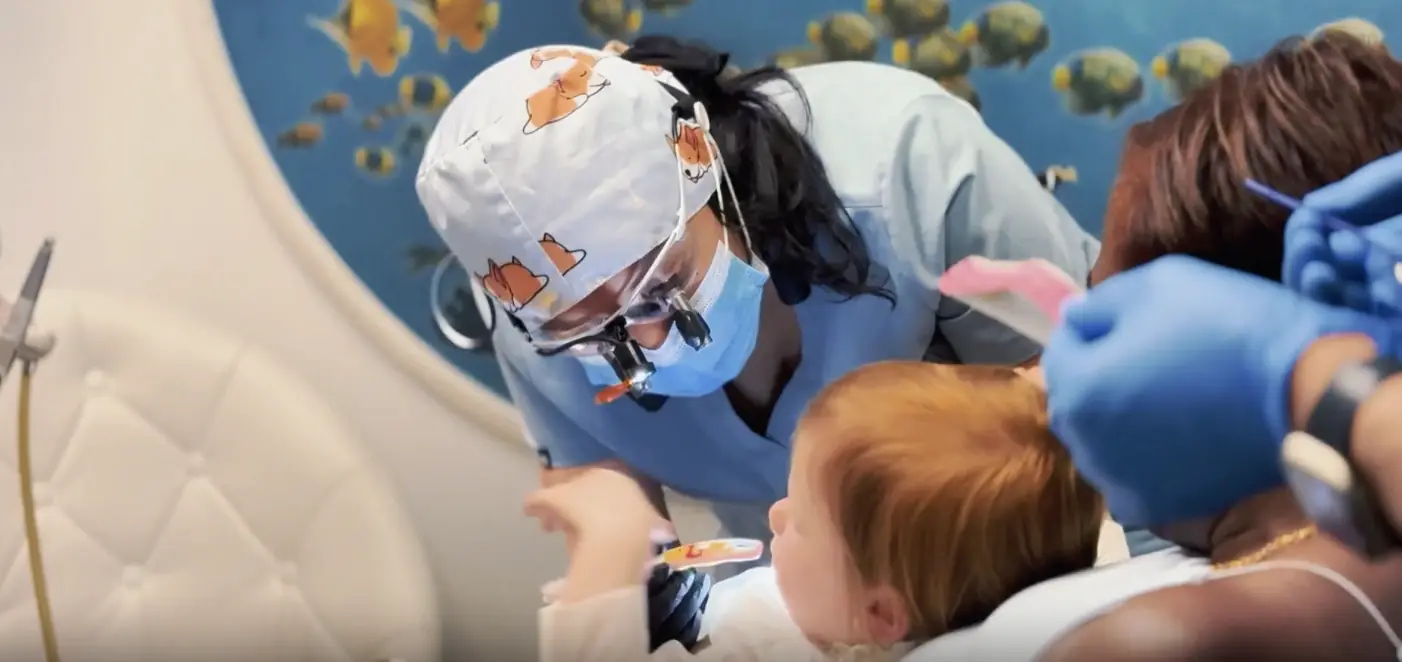
Pediatric Dentist in New York City
Looking for a pediatric dentist in New York? I'm Dr. Nina — here's what a kids-only dental office in Manhattan does differently, and why parents choose us.
Braces for Kids in Battery Park City
Braces for kids in Battery Park City: what parents near Rockefeller Park and the Esplanade should know about timing, expanders, and aligners.
Braces for Kids in the East Village
Braces for kids: when to start, what the evaluation covers, and the simple subway trip from the East Village to our Warren Street office in Tribeca.

Braces for Kids Near FiDi: A Parent's Guide
Braces for kids one subway stop from FiDi: Dr. Nina explains the first orthodontic visit, treatment options, and comfort-first care in Tribeca.
Braces for Kids Near Greenwich Village
Braces for kids start with the right evaluation: the age-7 checkup, phase 1 and expanders, and the easy ride down from Greenwich Village to Tribeca.
Braces for Kids Near Hudson Yards
Braces for kids for Hudson Yards families: the age-7 first checkup, Phase 1 options, and the 7-train ride to our Tribeca office on Warren Street.
Braces for Kids in Lower Manhattan
Braces for kids near Lower Manhattan: Dr. Nina on the age-7 checkup, braces vs. aligners, and the quick trip from Fulton Street to Tribeca.

Braces for Kids: Meatpacking District Guide
Braces for kids: a Meatpacking District family's guide to timing, Phase 1, expanders, and aligners — one quick ride downtown to our Tribeca office.
Braces for Kids in Tribeca: When to Start
Braces for kids work best when timing is right. I explain when Tribeca kids start, what the evaluation covers, and how to reach our Warren Street office.